


A series of landmark milestones underscoring Shenzhen’s progress toward building a world-class science hub were announced at the opening ceremony of the Guangming Science City Forum 2025 on Dec. 4.
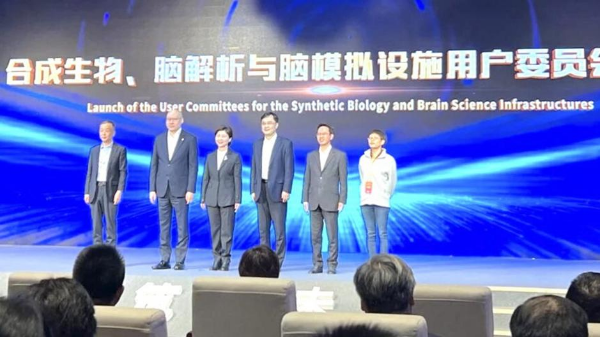
Among the achievements unveiled were the trial operations at the National Industrial Innovation Center for Bio-manufacturing; the completion of Phase II of the Seventh Affiliated Hospital of Sun Yat-sen University (Shenzhen); the launch of the Guangming Sci-tech Mother Fund and the establishment of its first batch of sub-funds; the formation of user committees for Synthetic Biology and Brain Science infrastructures; and the unveiling of the Shenzhen Center for High-end Scientific Instruments under the National University Regional Technology Transfer Center (GBA).
As China’s only national industrial innovation center dedicated to biomanufacturing, the National Industrial Innovation Center for Bio-manufacturing is expected to strengthen the entire innovation chain.
“The center is designed to address the core bottleneck of biomanufacturing: bridging the ‘innovation gap’ between lab discoveries and industrial-scale applications,” said Liu Chenli, president of the Shenzhen Institutes of Advanced Technology under the Chinese Academy of Sciences.
Another major milestone is the completion of Phase II expansion of the Seventh Affiliated Hospital of Sun Yat-sen University. Designed around a patient-centered philosophy, the hospital, with a total floor area of 700,000 square meters, breaks traditional departmental boundaries and offers modular shared facilities for outpatient, diagnostic, and inpatient services.
The establishment of user committees for major scientific facilities also drew strong interest from the industry. Zhang Guonan, vice chairman of Kingsino Technology Co., a listed agricultural company specializing in pig farming and feed, said the committees will help accelerate innovation for enterprises like his.
“Now we no longer need to invest heavily in building our own lab-like facilities,” Zhang said. “Shared platforms significantly shorten our R&D cycles and help turn high-tech visions into reality.”
Charles M. Lieber, director of the i-BRAIN institute at the Shenzhen Medical Academy of Research and Translation, delivered a keynote speech titled Advancing Brain-Computer Interfaces. He outlined his vision for next-generation brain-computer interface (BCI) technologies and for positioning Shenzhen as a global leader in the field.
Lieber highlighted Shenzhen’s ideal innovation ecosystem — from the research environment of Guangming Science City to the city’s strengths in integrated circuit design, chip fabrication, and artificial intelligence. He also pointed to strengthening clinical collaborations with Shenzhen hospitals to ensure future BCI technologies can be safely translated into human therapies. “We're pretty excited about the progress since I came here seven months ago, especially regarding the building of infrastructure and the promise for the future,” he said.
Now in its third edition, the Guangming Science City Forum has grown into a highly anticipated global event. Following a “1+1+7” structure — one opening ceremony, one plenary session, and seven parallel sub-forums — the forum spotlights frontier science, industrial innovation, and open collaboration. Topics range from AI computing power to intelligent agent models, all aimed at fostering a high-level platform for idea exchange, resource sharing, and win-win cooperation.