


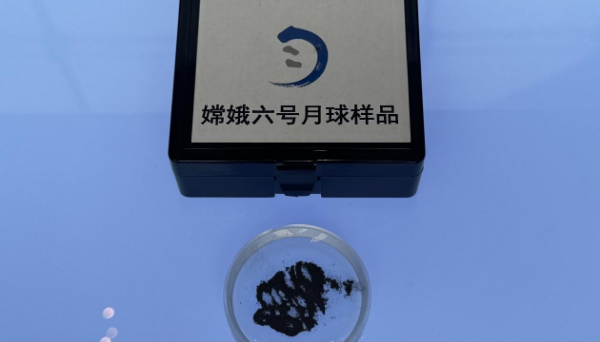
Lunar soil samples, from both the near and far sides of the moon, are on display at the Shenzhen Science & Technology Museum, marking a milestone for China’s lunar exploration program and offering visitors a tangible glimpse into deep-space exploration.
The display includes regolith collected by Chang’e-5 from the Mons Rümker region on the moon’s near side as well as samples from the South Pole-Aitken Basin — the world's first-ever retrieval from the moon’s far side — brought back by Chang’e-6.
These samples embody humanity’s dream of building a home beyond Earth, exhibition organizers said.
The samples are part of two parallel exhibitions that opened Dec. 6 — the “Embracing the Moon: China’s Lunar Exploration Program Achievements” exhibition and the “National Power: China’s Aerospace Hardware” exhibition. Together, they offer a unique celebration of China’s space achievements.
On display alongside the lunar samples is the recovered Long March-2F Y11 rocket. In 2016, this rocket carried astronauts Jing Haipeng and Chen Dong into orbit for a 33-day stay aboard the Tiangong-2 space laboratory, setting a national record at the time for the longest crewed space mission.
“Embracing the Moon — China’s Lunar Exploration Program Achievements” exhibition
Dates: Through Feb. 28, 2026
Location: 2/F, West Entrance Staircase Lounge, Shenzhen Science & Technology Museum.
“National Power: China’s Aerospace Hardware” exhibition
Dates: Through March 4, 2026
Location: 2/F, West Entrance Platform, Shenzhen Science & Technology Museum.