


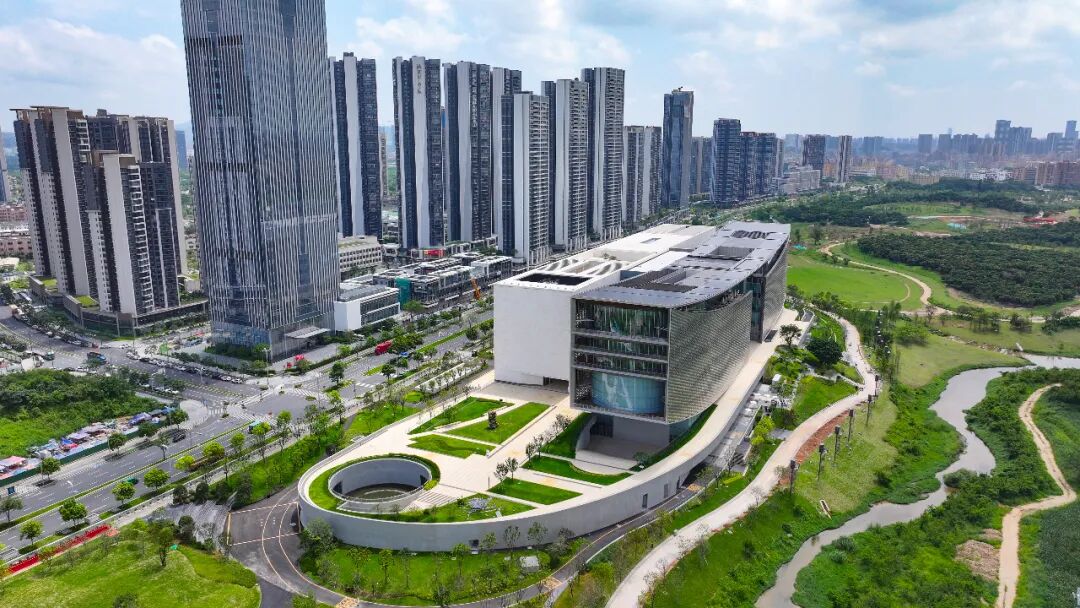
The Shenzhen International Museum of Art (SIMoA), Shenzhen’s latest landmark cultural institution, is set to officially open to the public May 30.
Located in the heart of the Guangming Science City, the museum is expected to become a world-class platform for artistic exchange, integrating academic research, exhibitions, public education, art collection and international collaboration.
Li Wenliang, chairman of Shenzhen Poly International Museum of Art Management Co., expected the museum to play a major role in driving Shenzhen’s cultural tourism and creative economy.
He said in an interview that the museum’s location in Guangming places it alongside major attractions including the Shenzhen Science and Technology Museum, forming a new cultural tourism destination for weekend getaways.
Li said operators of the museum also plan to develop cultural tourism products and immersive art experiences that integrate exhibitions, public programs and creative industries.
Describing the museum as one of Shenzhen’s key new public cultural facilities developed in recent years, Li said the museum is committed to cultural confidence.
He said the museum's curatorial philosophy is built upon three pillars: the dialogue between tradition and modernity, the exchange between Eastern and Western artistic traditions, and the integration of art and technology.
Based on these principles, the museum’s opening program will feature seven major exhibitions spanning ancient Chinese artifacts, modern Chinese masterpieces and international contemporary art.
Li said the museum’s ambition extends beyond Shenzhen to the entire Guangdong-Hong Kong-Macao Greater Bay Area (GBA) and the international art world. The institution is already teaming up with museums and cultural organizations across the region, including Hong Kong and Macao, to jointly organize exhibitions, educational initiatives and large-scale cultural events.
Li said that the goal is to build a shared cultural ecosystem that strengthens artistic exchange and contributes to the integration of cultural resources throughout the GBA.
He also highlighted the evolving role of culture in driving tourism and urban development across China, noting that “traveling to a city because of an exhibition” or “because of a performance” has become a burgeoning trend. This shift, according to him, underscores how culture can serve as a powerful attraction for visitors.
Li expected the museum's exhibitions to draw audiences from Shenzhen, the GBA, across China, and internationally, ultimately helping position Guangming as a major cultural tourism destination.
In addition to its exhibitions, the museum will host year-round public education initiatives, lectures and forums. From May 29 to 31, it will launch three consecutive dialogues featuring domestic and international scholars, artists and curators.